Hello! Because of the Eid holiday on October 1st, we have no classes for MAG2.0. I am hoping to reserve a classroom for October 4, Saturday, from 130-330PM. I hope that this schedule is amenable to everyone, as we need a day to have your creative projects presentations.
Thank you!
Thursday, September 25, 2008

Monday, September 15, 2008
Save Media Studies, Save the World!
Please disseminate (and dialogue) to your friends! :)
Sign up for Com 106: Media and Society [Media and Morality]! (Schedule Wednesdays 930-1230NN)

Traditional discussion of media ethics is usually confined with legal case studies, codes of ethics, and stiff admonitions of sex and violence in the media. This course then is not about these little ethics but about morality—that is, the consequences of media consumption and production to the very meaning of our humanity. Media & Morality asserts that our everyday choices with the media—from poking, friending, and flaming online to taking photos of tourist destinations to watching foreign-language films—reflect how we see, hear, and touch distant others and how we ultimately regard ourselves.
Some of the questions we ask include: How social are social networking sites? Are Facebook users narcissistic poseurs or can they also be self-aware beings-with-others? What is emo-journalism and how can it contribute to identifying with distant others? How well did The Guidon report on the Ateneo suicides? In using the words “suicide incident” over “tragedy”, what moral claim did they make about the living and the dead? When is a joke only a joke? What can we learn about Teri Hatcher’s and Malu Fernandez’s “jokes” about OFWs and their fiery aftermath? What charity ads encourage donation—those that invoke happy thoughts or those that invoke shame and guilt?
As a brand new elective, M&M is ideal for pop culture aficionados and aspiring media producers. It encourages creative work, as students will participate in a) designing humanitarian campaigns and presenting them to advertising professionals, b) pitching other-oriented documentary and telenovela story concepts to GMA executives, and c) organizing a media studies conference headlined by a Cambridge professor. This course is taught by Jonathan C. Ong, creator of the MediaTalk@admu series, former advertising and broadcasting executive, and firm believer that the media is at the heart of our moral future.
Sign up for Com 106: Media and Society [Media and Morality]! (Schedule Wednesdays 930-1230NN)
Some of the questions we ask include: How social are social networking sites? Are Facebook users narcissistic poseurs or can they also be self-aware beings-with-others? What is emo-journalism and how can it contribute to identifying with distant others? How well did The Guidon report on the Ateneo suicides? In using the words “suicide incident” over “tragedy”, what moral claim did they make about the living and the dead? When is a joke only a joke? What can we learn about Teri Hatcher’s and Malu Fernandez’s “jokes” about OFWs and their fiery aftermath? What charity ads encourage donation—those that invoke happy thoughts or those that invoke shame and guilt?
As a brand new elective, M&M is ideal for pop culture aficionados and aspiring media producers. It encourages creative work, as students will participate in a) designing humanitarian campaigns and presenting them to advertising professionals, b) pitching other-oriented documentary and telenovela story concepts to GMA executives, and c) organizing a media studies conference headlined by a Cambridge professor. This course is taught by Jonathan C. Ong, creator of the MediaTalk@admu series, former advertising and broadcasting executive, and firm believer that the media is at the heart of our moral future.
Thursday, September 4, 2008
Lecture 8: Catastrophe and Celebrity
HERE are the lecture slides for Catastrophe and Celebrity. And HERE are the lecture slides for Identity Politics.
Please post below if you intend to participate in the GMA Network Field Trip. We will meet 1PM at the Department of Communication and leave altogether. Please note that our meeting is at the Jamboree Gate. When asked by the guards, tell them that we are the Atenean guests of Neil Rara of Corporate Communications.
Please post below if you intend to participate in the GMA Network Field Trip. We will meet 1PM at the Department of Communication and leave altogether. Please note that our meeting is at the Jamboree Gate. When asked by the guards, tell them that we are the Atenean guests of Neil Rara of Corporate Communications.
Saturday, August 23, 2008
Special MAG2.0 Day: August 27
Please take note that Wednesday, August 27 is a special MAG2.0 day. Our class will be held at Social Sciences Building Conference Rooms 1 and 2. We will begin exactly 130PM. Howie Severino is a known stickler for time, and his lecture is for ONE hour only (130-230PM). On the second hour, I'll be doing a lecture on compassion fatigue. Don and Guia will also present for 12-15minutes on the readings. MAKE SURE you read 'Children Watching Children' written by moi. I'll get offended if you don't. :) On the third hour, we will have two guests do a talk on doing graduate studies abroad. In the spirit of media and GLOBALIZATION, of course. :)
As you can see, we have a jam-packed day ahead of us. Please come prepared. And early. I cannot stress this enough.
I also require you to submit to me a typewritten description of your ideas for the creative project. Indicate what you wish to do and what concepts you'll be using in a paragraph or two. AND you are also required to submit, on a separate sheet, your research question/s for the topic that you have selected for your final paper. Creative project and final paper groups are required to meet with me for consultation between Tuesday and Friday this week.
See you Wednesday!
Friday, August 15, 2008
Reading: Children Watching Children
Hi. We're moving up our Lecture on Catastrophe and Celebrity to Wednesday, August 20. As we're meeting Howie the following week, it would be effective if we discuss issues related to journalism and media ethics.
For our class on Wednesday, the required reading is my own study "Children Watching Children: How Filipino Kids Represent and Receive News Images of Suffering". Please download this HERE (Filename: CWC for JCM submission24Mar.pdf). I would appreciate it if you come to class prepared with the article.
We also have two special guests coming over to talk about graduate studies abroad. This talk will be reserved for the last 45minutes of class.
Wednesday, August 6, 2008
Lecture 7: Nation and Migration
HERE are the lecture slides for download. Unfortunately, I had to cut some of the stalker photos because they make the file too large.
We didn't have time to discuss and reflect on concepts of nation and diaspora. I hope that we use this space to think through some of the questions below:
1) How do Yao's, Cabanes' and Lorenzana's papers talk to one another? How are they similar or different? What are their theoretical, methodological and ethical strengths and weaknesses? What are their central arguments about migration, identity, and the media?
2) What is the analytical value of Madianou's theory of mediation?
3) How does the media (“global, local, regional, mass, personalized…”) contribute to the survival or death of the nation?
4) Who do we consider diaspora? What about non-Tagalogs and their representation in Philippine media… people from Northern France in French media?
5) How might the media enable dialogue between dominant and marginal groups? What policies should we push for?
6) How do individuals strategically assert their identities in everyday life? When do we play up certain identities over others?
Next week, August 13, we'll have the following five groups present their audience studies:
1) Julia and Savan
2) Mikey, Candice and Meggie
3) Paolo and Portia
4) Margie and Jowee
5) James and Bam
Remember, the objective here is to see how certain individuals or groups make use of the media to reflect on their identity (you can focus on nation, race, gender or sexuality, or their intersections). You can also focus on identity in relation to issues of difference or otherness (us and them, compassion fatigue, etc.) Use the studies of Yao, Cabanes and Lorenzana as template as well as those of Madianou, Gillespie, Miller, Kim, Ang, Liebes and Katz, etc. (Consult audience studies lecture slides)
August 20th we'll have a lecture on Identity Politics and Resistance. And August 27th will be Howie Severino's guesting, where we will discuss ethical issues in journalism and television production.
Again, please email me to schedule consultations for your projects. Remember, I'll be away for two crucial weeks in September and will likely be hard-to-reach via email.
Mass Media in Malaysia Lecture
This is just to remind you that the Department of Communication is co-sponsoring, along with ACAS, a lecture by Professor Kokkeong on Media in Malaysia: The Peculiar Case of Mainstream Media versus Alternative Media on Tuesday, 12 August 2008 at 1:30-3:00 pm. This will be held in Conference Rooms 1 & 2 of the old Social Sciences Building.
Please email or text me if you are interested. Slots are limited!
A +2 in the final mark will be given to student/s who ask/s a critical question during the lecture. A +3 in the quizzes will be given to student/s who write/s a one-page assessment of Kokkeong's study identifying its strengths and weaknesses in terms of rationale, theory, methodology, findings, conclusion, ethics, etc.
This is a very good exercise, as much of MAG2.0 is about enabling students to be more reflective and reflexive about essays, readings, and case studies that you encounter in your different classes.
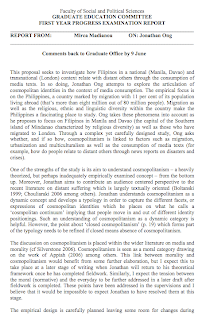
Here's an example of a review of an empirical study. Here, Mirca Madianou critiques my PhD proposal which aims to examine how Filipinos in different contexts relate with distant others in the media.

Please email or text me if you are interested. Slots are limited!
A +2 in the final mark will be given to student/s who ask/s a critical question during the lecture. A +3 in the quizzes will be given to student/s who write/s a one-page assessment of Kokkeong's study identifying its strengths and weaknesses in terms of rationale, theory, methodology, findings, conclusion, ethics, etc.
This is a very good exercise, as much of MAG2.0 is about enabling students to be more reflective and reflexive about essays, readings, and case studies that you encounter in your different classes.
Here's an example of a review of an empirical study. Here, Mirca Madianou critiques my PhD proposal which aims to examine how Filipinos in different contexts relate with distant others in the media.


Wednesday, July 30, 2008
Schedules and Readings
We had a really excellent presentation day today. I see that all the groups are skilled in identifying key concepts and applying them to their case studies. I hope that the audience studies groups do just as well, or even better, when they present on the 13th of August.
Next week, the 6th of August, we have Abby Yao (MA, University of London) and Jason Cabanes (ARI Fellow, NUSingapore) presenting their research on Filipino/a bloggers in London and Singapore and how they perform their identities online. I hope that you come to class ready to ask them challenging questions about their research.
The recommended reading is Mirca Madianou's "Contested Communicative Spaces" article from the Journal of Ethnic and Migration Studies. This is an excellent, easy-to-read study of how Turkish speakers in Greece negotiate their identities in their consumption of television news. However, you have the option to read the guest presenters' articles if you wish.
Here are the links below.
Madianou's "Contested Communicative Spaces" HERE.
Yao's "Pinay Brit Blogger" HERE.
Cabanes' "Pinoy Postings" HERE.
Please remember also that you should start thinking about your final papers and creative projects. Email me at jo296@cam.ac.uk or bertiebott@hotmail.com to schedule consultation. Have a good weekend!
Quiz 1 Hall of Fame
 I'm posting here Thibaut's winning answer to our first quiz. Everyone else, who got 9.5 and above, please post your answers here.
Monday, July 28, 2008
Announcement
We will resume classes on Wednesday, 30 July.
We will have the following groups do their textual analysis presentations:
1) Sam, Bea, Guia
2) Xela, Sylvain and Thibaut
3) Nyko and Martin
4) Karen and Avery
5) Don and Gia
I will also have a former MAG student present her final paper so that you get an idea about the quality of work that I'm expecting. The last hour will also be devoted to consultations for your final papers and creative projects.
See you then!
Tuesday, July 22, 2008
Announcement
Hi. We will NOT hold classes tomorrow, 23 July. Your trusty lecturer is ill. :(
Let's do online discussions for this week instead. Please check this board tomorrow for updates.
Also, you guys should start discussing ideas for your final papers and presentations already. Feel free to email me!
Let's do online discussions for this week instead. Please check this board tomorrow for updates.
Also, you guys should start discussing ideas for your final papers and presentations already. Feel free to email me!
Wednesday, July 16, 2008
Lecture 6: Being and Becoming
HERE are the lecture slides for Being and Becoming: Audience Studies in the context of globalization.
HERE are the lecture slides on Us and Them: Representations of the Other.
I encourage you to begin consulting with me with regard to your final papers. If you also need help with your quiz-presentations in the coming weeks, I am available for consultation. Just drop me a line at jo296@cam.ac.uk or bertiebott@hotmail.com.
Thursday, July 10, 2008
Final Paper Topics
Hi. Here are the Final Paper topics.
You have about three weeks to finalize your specific research question and approach. I encourage you to do some audience studies (so far, a lot of you are choosing representations studies). But I hope the lecture next week will get you interested in audiences too! :)
1) Mediation of Hate: The CounterNarratives of ChikaTime, PerezHilton, and Other Vicious Blogs
2) Compassion Fatigue or Media Fatigue? Mediated Suffering and Audience Responses
3) Observing OFWs: Changing Representations of Filipina Migrants in the Media
4) The Exploding Other: When Enemies Appear in the Media Space
5) Dreams and Nightmares in the Global Village: Representations of Technology in the Media
6) Reflexive Journalism: Ethics, Compassion, and Politics in Journalists’ Memoirs
7) Dialogues with the Dead: Photographs of Mourning
8) Notoriety and Filipino-ness: Janina San Miguel, Dancing Prisoners, and Other Pseudo-Celebs and Discourses about the Nation
9) Them Reporting Us: The Reporting of Local Events by International News
10) Discourses of Dialogue and Dissemination: When Do We Favor One Over the Other?
11) Media and Morality: What Philosophical Tradition Should We Use in Prescribing a Moral Media?
Wednesday, July 9, 2008
Lecture 5: Us and Them
I have given up on Sendspace and now using MediaFire. Tell me if it's any better.
HERE are the lecture slides for Us and Them: Representations of the Other.
Next week, we'll have a 10-point quiz that covers the past five lectures ('global media, mediated globe' up to 'us and them') plus the reading by Gillespie on Media Audiences. Not only is this reading particularly well written and accessible, it is also extremely useful for our research paper in class AND your other classes. It discusses theories on media audiences as well as case studies that use them.
The following week (23 July), we'll have a presentation day where the following groups are to do a 20-minute maximum presentation, wherein they present a case study using textual/image analyses of representations of the Other. You can select any media text (newspaper article, movie, tv show, blog) and identify how the text (or texts) construct(s) the Other using particular codes, conventions, and narrative styles. I'll be grading you not so much on creativity of presentation but more on your critical thinking and ability to apply concepts that you have learned in class (e.g., Orientalism, agency, demonization, typology of suffering). As this is a class on globalization, we highlight of course the Other in terms of nation or race. But you can also link nation or race with gender, sexuality, social class, etc. The 20-minute time limit includes the time that you're spending to show the class the video clip or photographs or text. You are encouraged to use Powerpoint and present: a) context/background, b) key concepts or analytical tools used, c) findings and arguments, and d) conclusion.
1) Sam and Bea
2) Xela, Sylvain and Thibaut
3) Nyko and Martin
4) Karen and Avery
5) Don and Gia
I'll leave the choice of topic up to you. Some examples though: a) black culture in Kanye West's music videos, b) representations of non-Manilenyos in the Philippines in GMA sitcoms, c) 'Lost' castaways and their 'Others', d) typology of Philippine news about tragedies.
This counts as your second 10-point quiz.
The other groups are presenting case studies on media audiences in a later week. But perhaps you can already think about which group of people you want to interview and what tv show or movie or text you wish to discuss with them. I only ask you to conduct around 3 interviews/ casual chats and present your findings.
6) Julia and Savan
7) Mikey, Candice and Meggie
8) Paolo and Portia
9) Margie and Jowee
10) James and Bam
Some possible topics: a) Filipina mothers and Sex and the City: Negotiating Filipina femininity, b) children's responses to American Idol Gives Back, c) Public school students' responses to Gossip Girl: Dreams, Luxury, and Success, and d) fans of Ugly Betty vs Betty La Fea.
Again, you are free to consult me regarding any of your upcoming requirements. Have a good weekend ahead!
Sunday, July 6, 2008
Wednesday, July 2, 2008
Lecture 4: Reflections and Representations
HERE are the lecture slides for download.
Feel free to raise any questions or comments on today's lecture.
Also, I'd like to hear from you as regards the "Made in China: The Growing Dangers of the China Trade" Time magazine article. What might a discourse analysis of the text reveal?
Take note that this is a business article in Time magazine. The storytelling is supposed to be 'objective' and economics-oriented. However, we argue, from a constructivist viewpoint, that a particular story is being told about China and, at the same time, the West (i.e., America). And this story is using a kind of symbolic violence in that it favors ONE way of understanding China while excluding other narratives. And so, what are the 'regimes of truth' that can be gleaned from the text in terms of: a) nation and national identity, b) danger and safety, c) progress and modernization, d) East and West, e) imperialism, and others?
Some guide questions to help you:
1) Why the focus on pet food, toothpaste, toys and tires? What is the significance of these products?
2) How does the article talk about 'us' and 'them'? What words or phrases are used to construct or position the reader?
3) What is the significance of the 'seal of approval' by the US Department of Agriculture? What does it represent?
4) Imagine that the story is about the dangers of trading with the United States, and NOT with China. What kinds of words or phrases would have to be changed because these are not 'acceptable' or commonplace terms of describing America, or the West in general?
5) How does the article link with the larger discourse about the 'rise' of China as a superpower?
I think that this is a very good exercise in which we get to practice our textual analysis skills. Can we count this as a 5-point quiz? :)
Also, HERE are the possible topics for your final paper assignment. These are in no way final, etched-in-stone topics and you are free to play around with them. While the paper won't be due for another 3 months, it's good to start thinking about what you want to do. Feel free to email me at jo296@cam.ac.uk to set appointments for consultation.
Thursday, June 26, 2008
Lecture 3: Proximity and Distance
HERE are our lecture slides for download. I really really enjoyed our discussion yesterday. And I hope that you did too! Let's hope that we continue it online!
Here are some of the discussion questions. As always, feel free to discuss these or raise some other issues that you find interesting:
1) How can we relate the theories of mediation with the models of communication? Which story do you believe?
2) From your experience, when and how do the media connect? When do they separate?
3) Why or how do you privilege dialogue over dissemination? Why the nostalgia for dialogue in an age of dissemination/always-already mediation?
4) What is YOUR dream for perfect communication?
5) (Cf Xela's question about the teacher as a medium) Can you guess the main message or "ending" of the course?
Also, some of you have asked about consultation hours and contact information. Feel free to email me anytime at jo296@cam.ac.uk to schedule a meeting. My consultation hours are T/TH 3-430PM, but we can arrange to meet outside of this, if necessary. We can discuss concepts discussed in class that you need clarified, ideas that you have for your papers and projects, and any other thing remotely related to media and communications.
HOMEWORK:
1) The reading for next Wednesday is Exploring Media Discourse by Myra MacDonald. Chapter 1 is available for photocopy in the Filipiniana section of the library. Please get a copy!
2) Bring a print ad or a news article that we can analyze for its interesting portrayal of a particular country (e.g., Wow Philippines advert, business news about China, news coverage of French riots).
Wednesday, June 18, 2008
Lecture 2: Homogenization, Heterogenization
You can download the lecture slides HERE.
Today's lecture was kinda heavy, but I did think that it was provocative too. There's a lot of things to say about the changes in time, place, space, non-place, splace. Also, with the world being more similar AND more different due to complex interconnections. How do we describe what's happening in the world? In the home? In spaces cyber and human? With cultures and identities? And how do we (or should we) judge such novelties? What experiences do you have of time-space distanciation or compression? With the media connecting and separating the globe? Feel free to discuss any, or all, of these questions above. Or even the discussion questions below:
1) Have the media rendered space and time differences insignificant?
2) Why worth mentioning splaces/non-places?
3) Do shared and simultaneous experiences through the media integrate society?
4) BONUS: How do spaces become places? How can non-places become places?
Please read the Silverstone/Barnett reading for next week (Chapter 2 of Demanding World), available in the Filipiniana Section of the library.
Anonymous commenting now allowed! (But please always label your posts with your name!) Start posting!
Tuesday, June 17, 2008
Lecture 1: Global Media, Mediated Globe
You may download the lecture slides from the opening lecture HERE.
See you all tomorrow in COM C, Old Communication Building.
See you all tomorrow in COM C, Old Communication Building.
Monday, June 9, 2008
Getting to Know You
It seems most fitting for a class about media and communications to first have the predictable yet indispensable exercise of self-presentation in a mediated environment. Obviously the manner of communication in cyberspace is starkly different from face-to-face interaction, with the loss of many symbolic cues--from body language to the rise and fall of voice pitch. But much are added as well--from the adoption of avatars to the narrative closure afforded by one's writing of a beginning, middle, and end. And in both types of communication, the challenge is to make a good first impression. What is frustrating--and exciting--of course is that we simply don't know just how our audience will react, respond, remember, reply. And, with the affordances of technology, also: comment, forward, poke, reject, block, digg, flame, spam.
However this site, and this class, is a site of hospitality. It is a site of learning and exchange. It aims to be a space premised not simply on reason and/or emotion, but on responsibility, Roger Silverstone's (2006) lofty requirement for a mediaspace. This homepage is home.
I am happy to welcome you to the website of Com110.10 Media and Globalization (Year 2). I wish that you treat this online space not simply as a supplement to our offline lectures but as a meaningful resource for learning, an active and vibrant space for discussion, and a shared experience with your fellow classmates and lecturer.
Kindly reply to this post and introduce yourself below so that we can get our discussions going. Aside from your name and course, I'd like to know your expectations of MAG2.0. Additionally, you have the option of answering any, or all, of the following questions:
1) how have the media influenced your perceptions or expectations about a particular person or place? how did your prior mediated experience affect, if at all, your actual encounter with that person or place?
2) how much time do you spend in shopping malls and chains such as Starbucks, McDonald's, etc? do you consider yourself a fan of such outlets? why? how?
3) American Idol or Pinoy Idol? Amazing Race or Amazing Race Asia? What can you say about global brands and their local spin-offs?
Switching to a different medium, please bring a 5x7" index card with 2x2" ID photo on June 18, Wednesday. Please include: name, birth date, and contact information (cell phone and email address).
Please be prepared with the de Block & Buckingham and/or Rantanen readings.
Subscribe to:
Posts (Atom)